From Ulaanbaatar to Antalya: What cities won at COP17, and what they still have to fight for
For the first time, a declaration from mayors and governors entered the formal record of a UNCCD COP. Beyond this milestone for cities and regions, COP17 advanced new finance for land and drought resilience and built momentum for greater coherence across the Rio Conventions.
When the UN Convention to Combat Desertification (UNCCD) COP17 closed in Ulaanbaatar, Mongolia, on 28 August after two weeks of negotiations, Parties had adopted 34 decisions to advance the global response to desertification, land degradation and drought. The scale of the challenge is immense: Up to 40 percent of the world’s land is affected, with more than three billion people living in areas already experiencing the consequences.
Governments, development banks, funds and companies announced USD 1.3 billion in new and pipeline finance for land restoration and drought resilience across 23 countries. The new Drought Resilience Investment Facility (DRIF), aims to mobilize up to USD 400 million in public and private capital. And a high-level dialogue advanced a proposal for a Rio Synergies Group for Action to connect climate, biodiversity and land priorities through more coherent implementation.
For cities and regions, another development was particularly significant: At the closing plenary, Parties formally recognized the outcome of the UNCCD COP17 Mayors’ Forum, taking note of the Ulaanbaatar Declaration and deciding to annex it to the official COP17 proceedings.
As the architecture for implementing that work takes shape, the question for cities and regions is what place they hold inside it.
A political statement by mayors and governors now sits inside the documentary record of a UNCCD COP.
Among the three Rio Conventions, the UNCCD is where the urban dimension has developed most slowly. Biodiversity COP has Decision 15/12 and the only formally adopted advisory mechanism on subnational governments across the three Conventions. Land has largely been handled as a rural file.
The territory says otherwise: Drought, ecosystem degradation and water insecurity affect where people live, how food reaches cities, where water comes from and how communities respond to climate extremes.
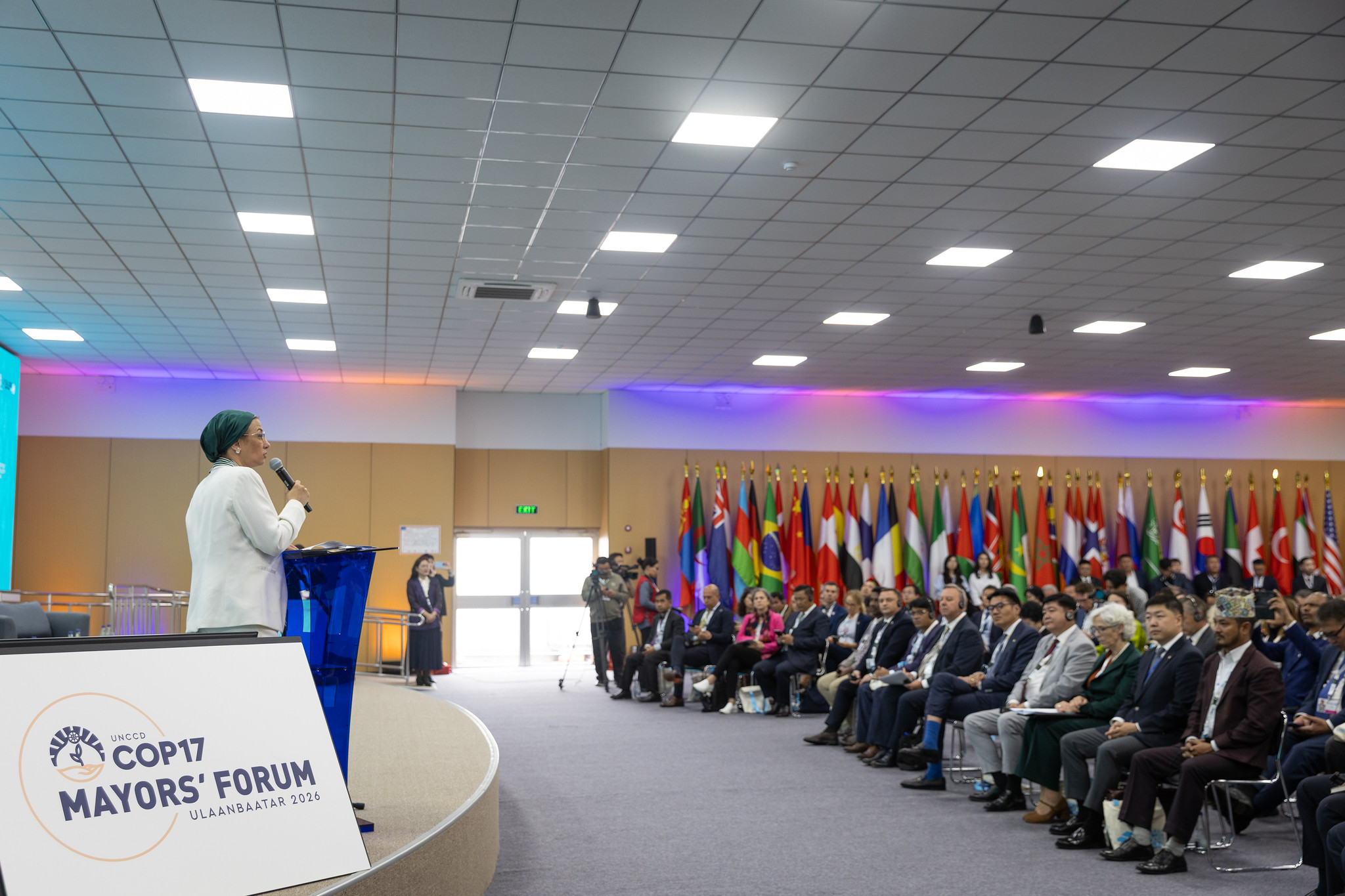
The UNCCD COP17 Mayors’ Forum was built to carry that argument politically. Held from 20 to 22 August in the Blue Zone as part of the official COP17 program, it was hosted by the Governor’s Office of the Capital City of Ulaanbaatar and co-organized by the UNCCD Secretariat, UN-Habitat, the Local2030 Coalition and ICLEI, with UCLG as key partner through the Global Taskforce. More than 200 participants from over 30 countries attended, some 30 of them mayors and governors, continuing a line that runs from Bonn, Germany in 1999 to COP16 in Riyadh, Saudi Arabia.
The resulting Ulaanbaatar Declaration on Local and Regional Governments recognizes urban, peri-urban and rural areas as interconnected territories and calls for approaches that address land degradation, biodiversity, climate resilience, water scarcity and sustainable urban development together.
But it also goes beyond local action, calling for a new era of multilevel environmental governance in which local and regional governments are “systematically engaged in the design, financing, implementation and monitoring of global commitments.” In decision ICCD/COP(17)/L.4, Parties welcomed the Forum, took note of the Declaration with appreciation, and annexed it to the official COP17 report.
This gives the Declaration a place in the formal record and signals Parties’ recognition of the contribution of local and regional governments. Although this does not yet institutionalize the role cities and regions are asking for, it moves the conversation from recognition toward defining what meaningful participation could look like during and between COPs.
Ulaanbaatar also put forward a practical test through the Ulaanbaatar Initiative, which will explore ways for cities to measure and report land degradation, with findings to be shared with the UNCCD by COP18. This connects participation with another challenge: making local contributions to restoration visible and measurable.
An unprecedented number of agenda items were blocked from consideration at COP17. Among them was agenda item 4, on relationships with other conventions and international organizations, which the United States objected to including. As a result, the COP agenda item on synergies was not discussed. Items on gender and civil society participation were similarly blocked and deferred to UNCCD COP18.
But the conversation on coherence continued outside the formal negotiations. Under the COP17 Action Agenda, the UNCCD COP17 Presidency and the incoming Presidencies of CBD COP17 and UNFCCC COP31 convened a High-Level Dialogue that launched a COP31 Presidency Process, led by Türkiye, toward a proposed Rio Synergies Group for Action. This voluntary, country-led group would connect existing national climate, biodiversity and land priorities with finance, expertise and partnerships, rather than create another parallel structure. It is expected to launch at COP31 in Antalya.
At the Mayors’ Forum, ICLEI released its Global Position on Rio Synergies, setting out local and subnational government perspectives on advancing coherence across climate, biodiversity and land. The paper’s core argument: Cities and regions don’t experience these as separate crises; decisions about land, infrastructure, water, food systems and development touch all three at once. On that basis, ICLEI calls for integrated implementation across the three Rio Conventions, with local and regional governments recognized, empowered and adequately resourced as implementation partners, including a role in negotiated decisions.
The release built on groundwork laid at the previous COP. At UNCCD COP16, the Mayors’ Forum had committed to an annual dialogue on local and subnational action across the three Rio Conventions, to be carried through the Daring Cities Forum. ICLEI and the Federal City of Bonn made good on that commitment in 2025, publishing the first Annual Review of Local and Subnational Action on the Rio Conventions alongside the mid-year UN climate negotiations. The Global Position, released at COP17, extends that same commitment.
Its release also landed at a moment of fresh institutional opportunity: The COP17 High-Level Dialogue’s proposal for a Rio Synergies Group for Action. Whether that country-led mechanism creates room for local and regional governments, the actors the Global Position argues should be built in from the start, remains an open question the paper itself puts on the table.
The money moved. Reaching territories is the next test.
The Rangelands Flagship Initiative brings together USD 1.2 billion across 45 projects, the largest single mobilization for rangelands in the Convention’s history.
On 25 August, the COP17 thematic day on water, the UNCCD and Luxembourg launched the Drought Resilience Investment Facility, aiming to mobilize up to USD 400 million and marking a shift from managing drought as a recurring emergency toward investing in resilience before it arrives. The negotiations behind it did not keep pace: Parties reached no substantive agreement on drought and carried the discussion to COP18, where it becomes a standing agenda item. Mobilizing capital is one question; whether it reaches the territories where restoration happens is another.
ICLEI South America brought a concrete example to COP17. Together with Consórcio Nordeste -Brazil’s nine Northeastern states-, it put restoration of Brazil’s Caatinga biome, the largest continuous dry tropical forest in South America, and the emerging Caatinga Fund on the agenda. This matters as countries translate national targets into action. At COP17, Brazil presented a voluntary 2030 Land Degradation Neutrality target that includes restoring more than 163,000 km² of degraded land. The challenge is connecting commitments of that scale with the governments, projects and finance capable of delivering them on the ground.
ICLEI South America and Mercociudades also brought a Regional Position Statement to Ulaanbaatar, with nine priorities including integrating UNCCD objectives into urban and territorial planning and opening more direct international finance to subnational governments.
Featured photo: © UNCCD/Kiara Worth