Cities, the Paris Agreement and the missing link to climate implementation
At COP31 in Antalya, the high-level opening of the Multilevel Action Pavilion exposed a persistent gap in global climate governance: Cities and regions are responsible for delivering much of the Paris Agreement, yet their role in shaping national commitments, accessing finance, and influencing international negotiations remains limited. Leaders called for permanent mechanisms that give local action a place in the system.
“The network is ready. What it needs is a place in the system.”
With these words, Katrin Stjernfeldt Jammeh, ICLEI President and Mayor of Malmö, Sweden, captured a central challenge facing international climate cooperation. Cities and regions have spent decades developing climate policies, mobilizing communities, and investing in solutions. Yet the decisions that determine their capacity to deliver are often made elsewhere.
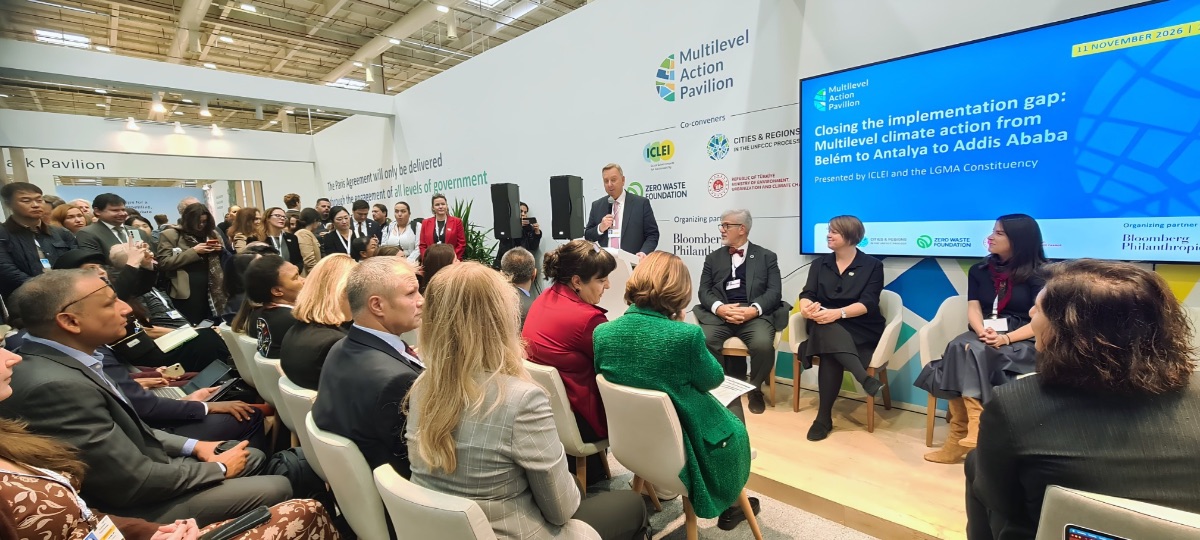
The stakes are growing. With sustained warming above 1.5°C increasingly expected, every fraction of a degree and every year of overshoot carries consequences for communities. The Multilevel Action Pavilion opened on 11 November with the high-level session “Closing the implementation gap: Multilevel climate action from Belém to Antalya to Addis Ababa.” At the session, ICLEI Secretary General Gino Van Begin framed the urgency:
“That overshoot is not a surrender. Every tenth of a degree that we can avoid with our policies, with our measures, and every year that we can shorten this overshoot, will mean that we can save lives, that we can save and protect our homes and our livelihoods.”
The question now is whether international climate governance can evolve quickly enough to make full use of the delivery capacity already available.
The discussion brought together mayors, regional leaders, national negotiators, UN agencies, and international partners. At its center was the COP31 Position of the Local Governments and Municipal Authorities (LGMA) Constituency, endorsed by 80 networks worldwide and handed over to the Australian COP31 Presidency of Negotiations.
The network is ready. Is the system?
The Paris Agreement relies on national commitments, but their implementation depends heavily on decisions made below the national level. Local and regional governments shape transport, buildings, land use, energy systems, and adaptation infrastructure. Their authority and resources, however, rarely match the responsibilities they carry.
Malmö offers a practical example of how this relationship can work differently. Its Climate City Contract brings municipal and national authorities around shared commitments toward climate neutrality by 2030, establishing responsibilities across levels of government.
“That is what we ask for in this process: not a dialogue once a year, but a standing place where national and local governments actually sit together,” Stjernfeldt Jammeh said.
The LGMA’s six asks for COP31 address the institutional conditions behind effective implementation: accelerating the energy transition, ensuring a just transition, improving multilevel climate finance, strengthening science-based action, establishing regular dialogue within the UNFCCC process, and advancing adaptation with meaningful subnational participation.
For Kostas Bakoyannis, Chair of the European Committee of the Regions’ ENVE Commission, the next step is explicit:
“However, recognition, dear friends, is not enough. The next step must be formal and structured inclusion in the negotiations.”
That demand is gaining political ground through the Coalition for High Ambition Multilevel Partnerships (CHAMP). Ambassador Da Costa, representing Brazil as CHAMP Co-Chair, outlined the coalition’s developing governance arrangements, including a steering group and Subnational Advisory Council.
Anne Hidalgo, Global Ambassador of the Global Covenant of Mayors for Climate & Energy and Chair of CHAMP’s Subnational Advisory Council, called for multilevel partnerships to be explicitly recognized in any COP31 delivery plan.
The significance extends beyond participation in negotiations. Institutionalizing multilevel cooperation could change how national climate plans are developed, how investment priorities are determined, and how progress is assessed. It could also provide a practical model for strengthening multilateral cooperation at a time when international institutions face growing pressure to demonstrate results.
Climate change doesn’t happen in national averages
The limitations of current governance become particularly visible in adaptation.
“National averages do not tell us much. They do not tell us which neighborhood actually floods, which regions will burn or which community will run out of water,” Bakoyannis observed.
His intervention points to a critical weakness in how climate progress is often measured. National indicators can conceal differences in exposure, vulnerability, and local capacity. Adaptation policies need territorial evidence that identifies where risks are concentrated and which communities require urgent support.
In Boulder, Colorado, Mayor Aaron Brockett described the consequences of floods, drought, extreme heat, and devastating wildfires. The city tracks climate progress through a public dashboard, while Boulder and Boulder County have pursued litigation against fossil fuel companies over climate-related costs.
Such experiences raise questions about who contributes evidence to national assessments and whose knowledge informs adaptation priorities.
The forthcoming Intergovernmental Panel on Climate Change (IPCC) Special Report on Climate Change and Cities, expected in March 2027, offers an opportunity to strengthen the scientific basis for urban climate action. Its findings could also inform the next Global Stocktake, particularly if local data and implementation experience are incorporated into assessments of collective progress.
UN-Habitat Executive Director Anacláudia Rossbach highlighted the Global Urban Stocktake as a mechanism for making local contributions more visible within international climate processes.
The political implications are substantial. Better territorial evidence can improve the design of national adaptation plans, guide investment toward vulnerable communities, and reveal whether climate commitments are delivering protection where it is most urgently needed.
Climate ambition needs a budget, a plan and someone accountable
For local governments, the financing gap is often where climate ambition encounters its most immediate constraints.
Ahmet Aras, Mayor of Muğla, Türkiye, described a municipal climate action plan with 38 measures, alongside investments in solar energy, waste management, biogas, electric mobility, and water infrastructure. The municipality is also pursuing an approximately €63 million water-loss reduction project supported by the European Bank for Reconstruction and Development.
Aras offered a practical test for turning commitments into results:
“For every climate target, we should ask: What will we build or change? How much will we reduce emissions? Who will be responsible? Where will the funding come from? And how will we measure success?”
These questions reach into the institutional mechanics of climate delivery. Projects require technical preparation, financing arrangements, regulatory coordination, and clear responsibilities. Without these elements, even ambitious national commitments can struggle to produce measurable outcomes.
Ingrid-Gabriela Hoven, Managing Director of GIZ, highlighted the role of project-preparation mechanisms, including the City Climate Finance Gap Fund, in helping municipalities develop investment-ready proposals.
Kelly Shultz of Bloomberg Philanthropies drew on New York City’s building energy efficiency experience to illustrate how federal funding, state-level technical leadership, and municipal regulation can reinforce one another.
The Australian COP31 Presidency of Negotiations also recognized the importance of simpler, fairer, and faster access to climate finance, particularly for vulnerable communities in the Pacific.
Financing arrangements therefore need to reflect the realities of implementation. Municipalities require the capacity to prepare projects, predictable support across levels of government, and access to funding mechanisms capable of responding to local priorities.
Turning political momentum into institutional change
The high-level opening also revealed how the institutional landscape is beginning to evolve.
UN-Habitat outlined the High-Level Dialogue on Urban Resilience, Adaptation and Climate Action, convened with the COP31 Presidency during the World Leaders Summit. Bringing heads of state and government into discussions with ministers, mayors, governors, development banks, and climate funds creates an opportunity to connect urban priorities with national and international decision-making.
The dialogue places particular emphasis on adaptation, climate-resilient cities, housing, informal settlements, and the financing needed to translate plans into projects. UN-Habitat has also expressed its intention to work with Parties and incoming COP presidencies to sustain this political engagement.
CHAMP offers another route toward more structured cooperation. Hidalgo urged signatory countries to demonstrate how multilevel partnerships can produce tangible results for communities, setting an expectation that progress should become visible by COP32 in Addis Ababa.
Yet the immediate political test remains in Antalya.
The LGMA COP31 Position provides concrete measures against which to assess the negotiations: a regular space for multilevel dialogue, stronger participation in climate planning, improved access to finance, recognition of local scientific evidence, and adaptation frameworks that reflect territorial realities.
These demands also speak to a wider challenge for multilateralism. International agreements gain credibility when their commitments can be translated into policies, investments, and measurable improvements in people’s lives. Local and regional governments provide much of the institutional capacity needed to make that connection.
As COP31 negotiations continue, the question is whether Parties will establish more durable arrangements that match local responsibilities with meaningful authority, resources, and influence.
Cities and regions have demonstrated their readiness to deliver. What remains to be decided is the place they will occupy in the system responsible for delivering the Paris Agreement.