“We are not here to pay for other people’s mistakes”: Small islands make their case at COP31
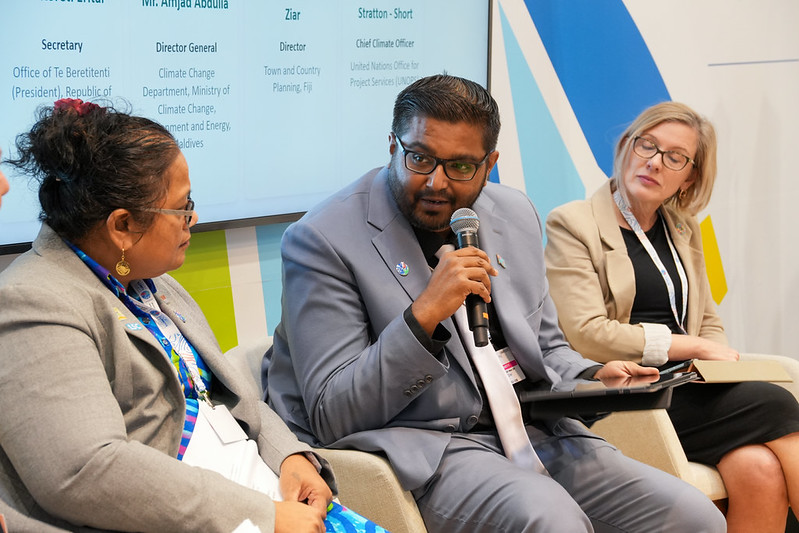
Small island developing states (SIDS) produce a tiny share of global greenhouse gas emissions, but they are among the first to face rising seas and stronger storms. “We’re not big emitters, yet we are paying the price for the countries that are emitting,” said Mohammed Ziar, Director of Town and Country Planning in Fiji. “We are not here to pay for other people’s mistakes.”
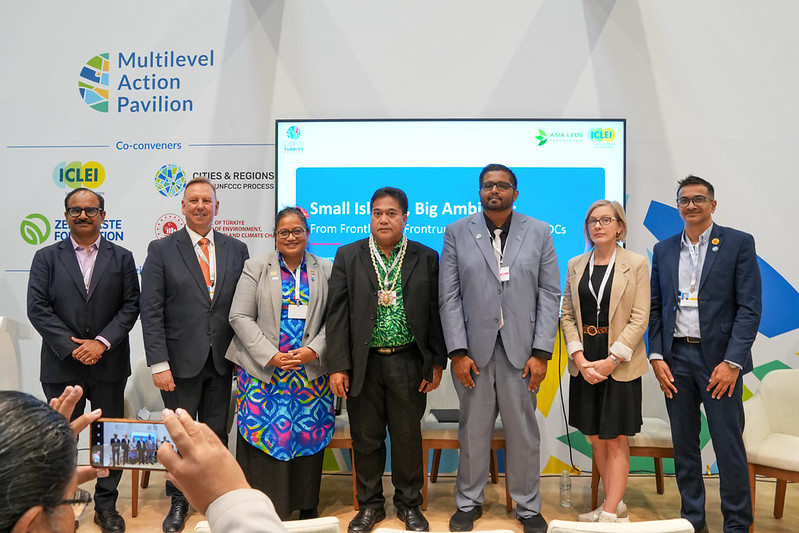
Ziar spoke at “Small Islands, Big Ambition: From Frontline to Frontrunner – Advancing NDCs,” a session organized by ICLEI and the Asia LEDS Partnership (ALP) at the Multilevel Action Pavilion. Representatives of Kiribati, Fiji, the Maldives, and the United Nations Office for Project Services (UNOPS) discussed how small islands are turning climate commitments into action, and what support they need to scale it up.
Acting anyway: Kiribati measures its emissions
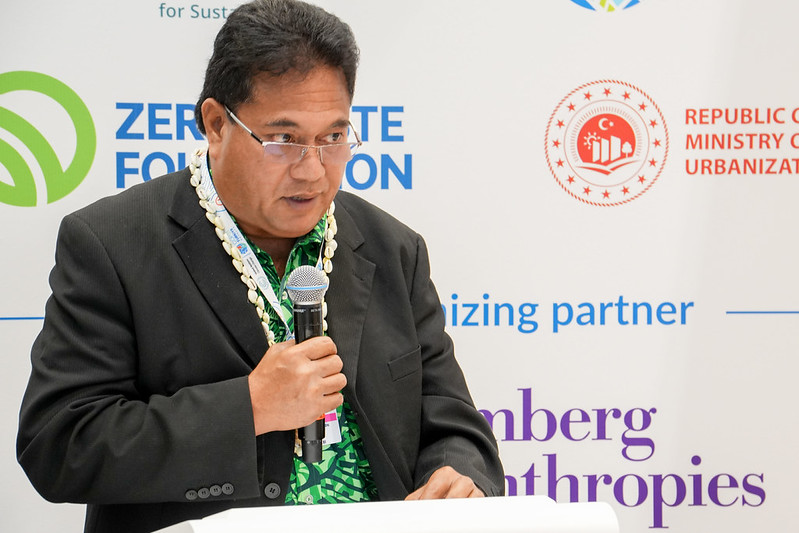
Kiribati is a case in point. On 1 October 2026, the country launched a nationally owned digital system for tracking, calculating, and reporting its greenhouse gas (GHG) emissions, among the first of its kind in the Pacific. It was developed by ICLEI South Asia, as the ALP Secretariat, in partnership with the Climate Change and Disaster Risk Management Division of the Office of Te Beretitenti (the Office of the President), and supported by the NDC Partnership. Kiribati’s Minister for Employment and Human Resources, Hon. Auria Kitina, delivered the session’s keynote.
Nikhil Kolsepatil, Senior Programme Coordinator for Energy and Climate at ICLEI South Asia, demonstrated how the system works. A dashboard shows national emissions by sector, gas, and fuel, and how they change over time. Government departments enter data through an online portal using ready-made templates, and department heads review and approve the figures. Results follow the reporting formats of the Intergovernmental Panel on Climate Change (IPCC), so Kiribati can use them directly in its national reporting.
Early data already point to where action is needed: transport is a major source of emissions. Emani Kumar, Deputy Secretary General of ICLEI, said ICLEI is now discussing with the Pacific Community (SPC), Australia, and New Zealand whether the dashboard could be adapted for other Pacific nations.
Built to stay in Kiribati
The project focused on making sure the system outlasts it. ICLEI South Asia trained members of the Kiribati National Experts Group and officials from several ministries on emissions calculation, data management, and quality control. When the system launched, the tools, templates, and guidance were formally handed over to national institutions.
At the launch, Roreti Eritai, Secretary of the Office of Te Beretitenti, said the platform would strengthen Kiribati’s voice in advocating for the 1.5°C limit, while anchoring domestic policy in solid data. In Antalya, she described how climate decisions reach communities: a national experts committee brings together ministries, the private sector, and civil society, including representatives of women and people with disabilities. On the outer islands, island councils run disaster committees that link communities to national decision-making.

Data is only the first step
Partners agree that the value of good data lies in what it unlocks. At the Tarawa launch, Meredith Ryland, Acting First Secretary at the Australian High Commission in Kiribati, said Kiribati’s leadership in bringing this data together strengthens the basis for attracting international climate finance.
Samantha Stratton-Short, Chief Climate Officer at UNOPS, which hosts the NDC Partnership and the Global Climate Action Partnership that the ALP is part of, made the same point. “What matters now is that the data leads somewhere: into planned projects that get financed,” she said. The next step is to link the inventory to Kiribati’s Nationally Determined Contribution (NDC) Implementation Roadmap and Investment Plan, now under review, so it feeds a pipeline of projects that partners can finance. She pointed to Fiji, where a roadmap for electric vehicle adoption prepared with the government led to the launch of an electric mobility project in March 2026.
Amjad Abdulla, Director-General of the Climate Change Department at the Maldives’ Ministry of Climate Change, Environment and Energy, warned that ambition alone is not enough. “It has been more than ten years since Paris, and we are still seeing devastating impacts,” he said. He called for adequate, predictable finance, and stressed that closing the implementation gap matters as much as closing the ambition gap.
Small islands, city-sized challenges
Moderating the panel, Gino Van Begin, Secretary General of ICLEI, noted that many island states are comparable in population to medium-sized cities and face similar challenges, from waste to energy and mobility. He asked whether solutions developed by cities could serve as models.
For Kiribati, the most pressing constraint is land. Most land is customarily owned, and in South Tarawa the government must lease it. “The government needs to create land, and that will be land reclamation,” Eritai said. Kiribati plans to reclaim an area in South Tarawa and move ministry offices there, with renewable energy as part of the design. But reclamation is costly, and waste adds another pressure. “Where are we going to put our landfills? That’s our challenge,” she said. Any model from elsewhere, she added, must be adapted to Kiribati’s context.
In Fiji, Ziar explained, many town planning schemes date back 20 years and no longer reflect climate risks. The government is developing a 50-year master plan with disaster risk reduction built in, alongside a waste segregation project to be replicated across municipalities and plans for a regional landfill in western Fiji.
“Adaptation and resilience are very localized,” Van Begin said. “They need to take place on the ground, where people live.” ICLEI recently opened a Pacific office in Suva, Fiji, to support this work across the region.
For Ziar, the path is: “From being on the front line of climate change to becoming a frontrunner in climate change means translating our commitments into practical planning decisions and resilient, sustainable services that deliver lasting benefits to our communities.”