
China Cities Day: Five ways cities are putting biodiversity into action
What do a smart wetland monitoring system in Wuhan, a watershed restoration project in Baishan, and a breeding program for an endangered newt in Ningbo have in common? Each shows how local governments are turning biodiversity commitments into action, using different approaches to address the ecological challenges of their territories.
Across China and beyond, cities are demonstrating that protecting biodiversity is not simply about setting aside green spaces. It also means managing interconnected ecosystems, using technology to inform decisions, protecting vulnerable species, and finding ways to integrate nature into urban development.
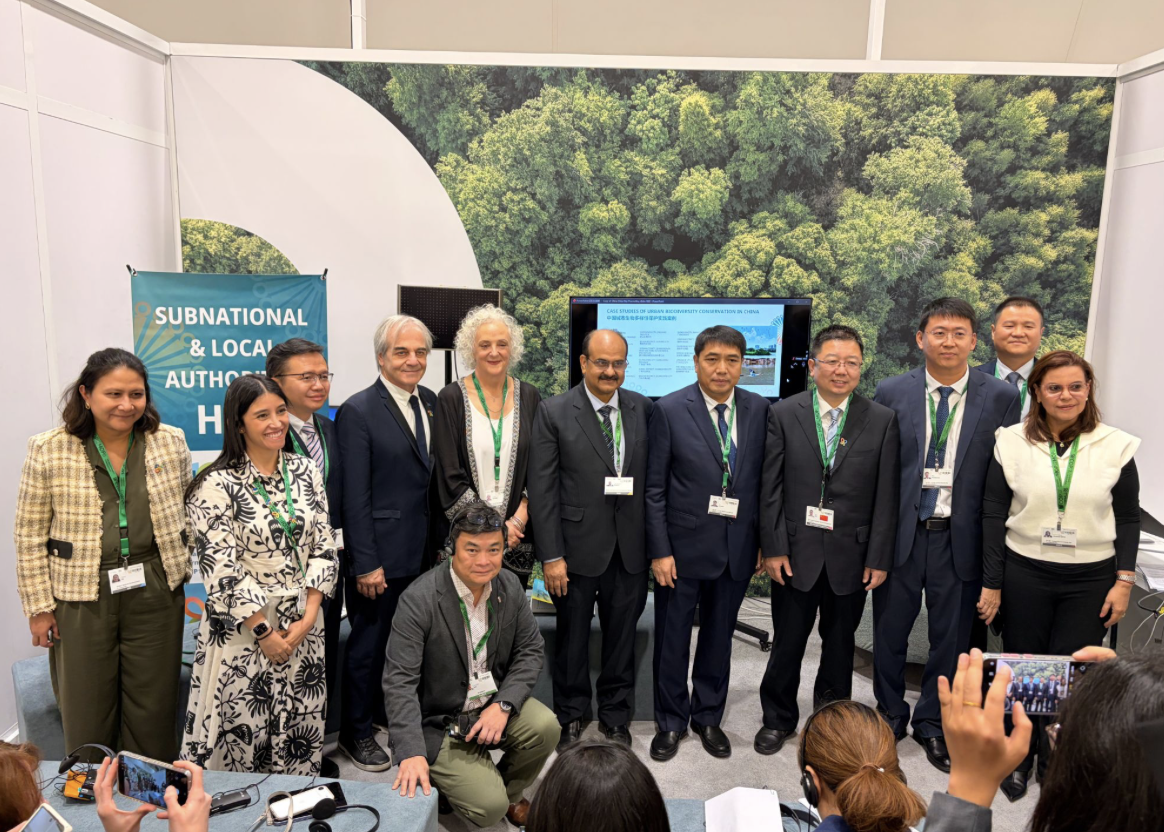
These experiences were among those shared at China Cities Day, held on 23 October during Biodiversity COP17 in Yerevan, Armenia at the Subnational and Local Authorities Hub. Organized by ICLEI, the Policy Research Center for Environment and Economy of China’s Ministry of Ecology and Environment, and the Tsinghua University Research Center for Ecological Civilization, the event brought together representatives from nine Chinese local governments and seven from six other countries to exchange practical approaches to biodiversity conservation.
Five approaches emerged from these exchanges, offering insights into how cities can translate the Kunming–Montreal Global Biodiversity Framework (KMGBF) into local action.
1. Think beyond city boundaries: Restore entire ecosystems
Rivers, forests, mountains, and wetlands do not follow administrative boundaries. Protecting them requires coordination across jurisdictions and an understanding of how different ecosystems are connected.
For example, China’s 2023 approach to conserving mountains, waters, forests, farmlands, lakes, grasslands, and deserts reflects the philosophy that nature is a single, interconnected system. Baishan City adopted this method in the Yalu River area, which begins in Baishan and runs along China’s northeastern border. In partnership with Tonghua City, Baishan launched the Yalu River Important Source Area Integrated Protection and Restoration Project to address water quality and land use together, linking mountain conservation upstream with river health downstream. Key actions include replanting slopes to reduce sediment, restoring riverbanks to prevent pollution, and managing agricultural runoff to protect the watershed. Similarly, Guizhou Province’s integrated restoration project in the Wuling Mountain Region has protected over 800,000 mu, reconnected habitats, and established wildlife corridors.
The lesson for other cities: Effective biodiversity conservation requires looking beyond individual parks, protected areas, or municipal boundaries. Coordinating land and water management across entire ecosystems can address multiple environmental pressures simultaneously.
2. Use technology to make biodiversity monitoring more effective
Understanding what is happening within an ecosystem is essential to protecting it. Yet traditional biodiversity monitoring often depends on periodic field surveys, which may not detect environmental changes quickly enough.
Wuhan City’s Smart Wetland System is a prime example of this advanced approach. By integrating IoT, AI-powered voice and image recognition, 5G networks, and big data analytics, the system enables continuous, automated monitoring across 16 nature reserves spanning 40,000 hectares. It tracks bird populations, monitors water quality, and models hydrological processes, providing real-time threat alerts and supporting informed conservation decisions. This technological advancement has led to notable improvements in water quality at key sites such as the Chenhu Wetland and has elevated scientific standards for biodiversity protection.
For local authorities, the value of this approach lies not simply in the technology itself, but in how monitoring data can inform management decisions and enable earlier responses to ecological threats.
The lesson for other cities: Digital tools can strengthen biodiversity management when they are connected to clear conservation objectives. Monitoring is most useful when the information collected translates into timely decisions and action.
3. Make nature part of urban development
Biodiversity conservation and economic development are often presented as competing priorities. Yet some cities are exploring how healthy ecosystems can contribute to urban attractiveness, tourism, environmental education, and quality of life.
For example, Singapore transformed its “Garden City” vision into a “City in Nature” framework, making ecological engineering projects like Gardens by the Bay, Jewel Changi Airport, and the Singapore Botanic Gardens global tourism icons. Through vertical greening, eco-friendly architecture, and an extensive Park Connector Network, Singapore seamlessly integrates nature into urban life, positioning itself as a leader in sustainable tourism and green events. Similarly, Beilun District in Ningbo has opened environmental protection facilities and industrial sites to the public, turning them into educational venues that showcase green transformation and biodiversity conservation.
Although these examples operate at different scales, both demonstrate how environmental initiatives can become part of a city’s broader development strategy.
The lesson for other cities: Integrating nature into urban development can create environmental, social, and economic benefits. The challenge is to ensure that these benefits support, rather than replace, measurable biodiversity conservation objectives.
4. Protect species through targeted local action
Cities and their surrounding landscapes can provide critical habitats for endangered species. Protecting them often requires interventions tailored to their ecological needs, supported by monitoring, habitat management, and effective enforcement.
Beilun District in Ningbo established a dedicated nature reserve and breeding laboratory for the Zhenhai spiny newt, a globally unique Class I protected species. More than 1,800 individuals have been bred in captivity, and the reserve has expanded from 200 to 12,000 square meters, supporting a steady rise in the wild population. In Shijiazhuang, the Taihang Mountain Minman River Black Stork Judicial Protection Base was set up as the city’s first specialized hub for conserving the endangered black stork. This center combines judicial enforcement, ecological restoration, and public education to prevent poaching and protect the river ecosystem. Meanwhile, Hong Kong has designated dozens of conservation zones—including 67 sites of special scientific interest and multiple protected areas—specifically for safeguarding wildlife.
These examples demonstrate how different conservation measures can be adapted to the needs of particular species and habitats.
The lesson for other cities: Species conservation requires more than designating protected areas. Targeted interventions, habitat management, monitoring, and enforcement can work together to address the specific threats facing vulnerable wildlife.
5. Connect local action with global biodiversity goals
Cities may face different ecological challenges, but many can benefit from exchanging experiences, using shared assessment tools, and aligning their strategies with international biodiversity targets.
At China Cities Day, ICLEI East Asia introduced two resources: Cities in Harmony with Nature: Case Studies of Urban Biodiversity Conservation in China and the Chinese edition of the Cities Biodiversity Index (CBI).
The case compendium showcases exemplary urban initiatives, highlighting the commitment, innovation, and progress of Chinese cities toward a vision of harmonious coexistence with nature. The CBI offers an essential framework for Chinese cities to systematically assess, monitor, and manage biodiversity, empowering urban leaders to embed conservation into every facet of planning and governance.
International collaboration also plays a role. With over 40 Chinese cities now part of the CitiesWithNature platform, local governments can connect their biodiversity efforts with a wider community of cities and regions.
“Reaching the KMGBF goals requires united action from local governments worldwide. Because ecosystems and migratory species cross borders, only global collaboration can effectively address the biodiversity crisis.” said Guoqiang Pan, Vice Mayor of Baishan Municipal People’s Government. This year, Baishan City joined the “CityWithNature” initiative to promote ecological restoration and species conservation.
Similarly, Guizhou Province uses international forums like the “Eco Forum Global Guiyang” to share its expertise in restoring karst ecosystems, fostering community co-management, and preserving agricultural heritage with global partners.
The lesson for other cities: Shared tools and international networks can help cities assess their progress, learn from comparable experiences, and connect local conservation measures with global biodiversity commitments.
From individual projects to lasting biodiversity action
The experiences shared at China Cities Day highlight a common principle: Protecting urban biodiversity requires integrating nature into how cities plan, manage, and develop their territories.
The approaches vary considerably. Baishan focuses on restoring interconnected ecosystems, Wuhan uses technology to strengthen environmental monitoring, and Beilun combines targeted species protection with environmental education. Other cities are exploring how green infrastructure, legal enforcement, and international cooperation can contribute to conservation.
None of these approaches offers a universal solution. Their relevance depends on local ecosystems, governance capacities, resources, and development priorities.
What they demonstrate, however, is that biodiversity action can take many forms, and that cities have practical tools at their disposal to move from global commitments to local implementation.
As governments work to deliver the Kunming–Montreal Global Biodiversity Framework, the experiences of cities already putting these approaches into practice offer a valuable starting point for learning, adaptation, and cooperation.
Bringing global perspectives to China Cities Day
The discussions also brought together international perspectives on biodiversity conservation and cooperation. Speakers included Kobie Brand, ICLEI Deputy Secretary-General; Jean Lemire, Special Envoy for Climate Change, Nordic and Arctic Affairs of Québec; Ajay Bhushan Pandey, Vice President for Investment Solutions at the Asian Infrastructure Investment Bank; and Hu Jun, Director of the Research Center for Environment and Economy at the Ministry of Ecology and Environment of China.
Moderated by Zhu Shu, Director of the ICLEI East Asia Secretariat and China Representative, the event highlighted the importance of international cooperation, nature-positive investment, and stronger partnerships between local governments to advance global biodiversity goals.


